
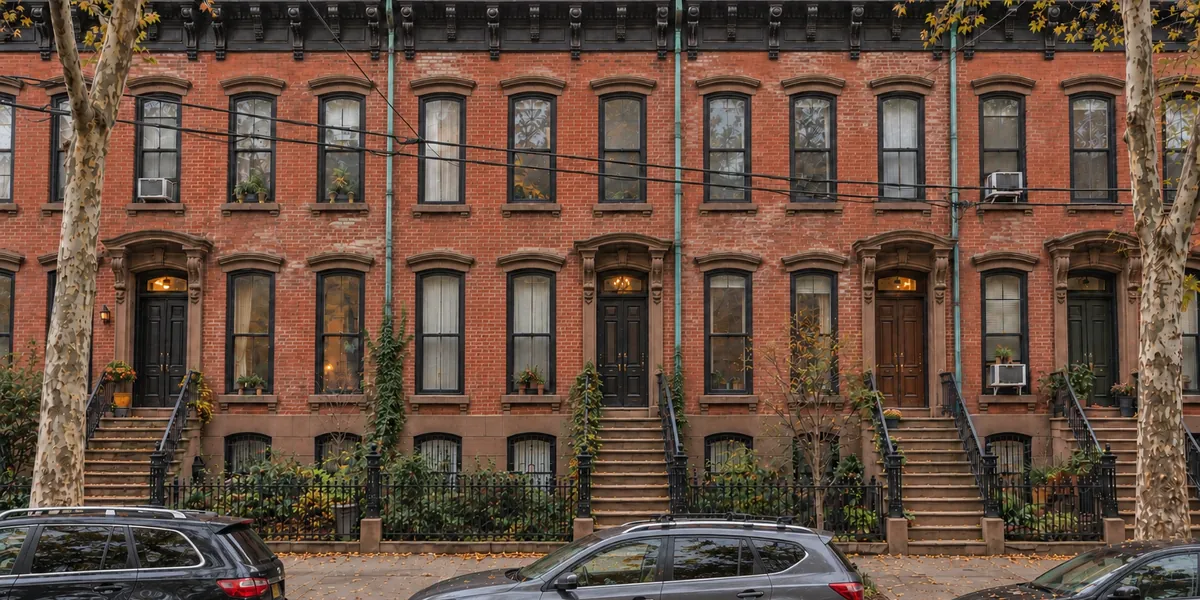
The shared cornice
One row, one cornice line
In downtown Jersey City, 19th-century rowhouses were built in continuous rows, and on many blocks the cornices line up into a single horizontal band along the street. On a lot of those houses, the gutter is inside that cornice. That makes gutter work here different from anywhere else in the city: a repair on one house affects how the whole row reads, and the city reviews changes before they happen.
Jersey City has five local historic districts. This page walks through them in order, then explains how review works and what to bring to it.
A walk through the districts
Five districts, five kinds of blocks
Paulus Hook
The oldest corner of downtown, near the Hudson waterfront. Its rowhouses are among the earliest in the city, built close to the street in continuous rows. On a block like this, a new gutter or leader on one house is seen against all its neighbors.
Van Vorst Park
Rows of brick and brownstone houses facing a landscaped square. Bracketed cornices with built-in gutters are common, and leaders run down the fronts toward the park.
Hamilton Park
Another set of rows arranged around a park, with high stoops and tall windows. Many cornices here still carry their original box gutters, some relined several times.
Harsimus Cove
The National Register nomination describes 431 properties, mostly brick Italianate rowhouses three stories over a raised basement, with brownstone lintels, high stoops and bracketed wood cornices, built mostly between 1850 and 1887.
West Bergen–East Lincoln Park
Up the hill near Lincoln Park, a later district with larger houses, including freestanding ones. Hanging gutters and leaders are more common here than cornice gutters, but changes visible from the street are still reviewed.
Request a free estimate
Prefer to talk? Call (201) 293-3992, Mon–Fri 7AM–9PM.
Request received.
A local specialist will reach out shortly. Urgent? Call (201) 293-3992.
How review works
Certificates, in plain words
According to the City of Jersey City, work in a historic district needs one of two approvals before it begins, "whether or not a construction permit is required":
- A Certificate of No Effect, for work that does not change the building's historic character. Rehabilitation, restoration, maintenance and repairs are handled at staff level.
- A Certificate of Appropriateness, for changes that do alter what the building looks like.
The city's published rules do not single out gutters, leaders or box gutters by name. In practice, relining a box gutter or replacing a leader in the same material and shape is the kind of repair that usually goes through staff, while converting a cornice gutter to a hanging gutter, or swapping copper for aluminum on a street front, changes the appearance. Homeowners should confirm with Historic Preservation Commission staff before any work begins.
On a shared row
Situations that come up on historic blocks
A box gutter that runs across two houses
Where a single cornice spans neighboring houses, the trough inside it can be continuous too. A leak on one side may start at a failed seam on the other. Relining only one house's half leaves a joint at the property line that has to be detailed carefully, and the best result usually comes when neighbors coordinate the work.
One house in a matched row
When every house on a block has the same copper leader and conductor head, replacing one with a different size, shape or metal stands out. Matching the neighbors is usually the path of least resistance with review, and often looks best too.
The rear of the house
Rear walls not visible from the street often have more flexibility, and many rowhouses have a flat roof that drains through a scupper in the rear parapet. That is frequently where the most practical upgrades happen, such as a larger scupper or leader, without changing the street face.
An old patch that hides the problem
Many cornice gutters have layers of roofing cement from past repairs. Removing them is often the only way to see what is underneath, so estimates on historic houses may include an inspection step before the final price.
Before the first call
What to bring to HPC staff
A short, complete package makes staff review faster:
- Photos of the front of the house, the cornice up close, and the existing leaders and conductor heads
- Photos of the neighboring houses on both sides, showing the shared cornice line
- A description of the problem: where water is getting in, and what has failed
- The proposed fix: patch, reline, rebuild or convert
- The proposed material and profile: membrane, copper or lead-coated copper; half-round or K-style
- Whether anything will change where it can be seen from the street
- The contractor's written scope of work
Jersey City and Hoboken
Two cities, two review processes
Owners with property on both sides of the city line, or contractors working in both, often ask how the processes compare:
| Jersey City | Hoboken | |
|---|---|---|
| What is reviewed | Exterior work in the five local historic districts | Any exterior addition, renovation or alteration visible to the public in a locally designated historic district |
| Approval needed | A Certificate of No Effect or a Certificate of Appropriateness before work begins, even when no construction permit is required | An application to the Historic Preservation Commission, including a form for general repairs and restoration |
| Repairs and maintenance | Handled at staff level | Not spelled out for gutters; the preservation office can confirm |
| Source | City of Jersey City | City of Hoboken |
Summarized from each city's historic preservation page, October 2026. Both cities' preservation staff can confirm what applies to a specific house.
The parts involved
Cornice to sidewalk
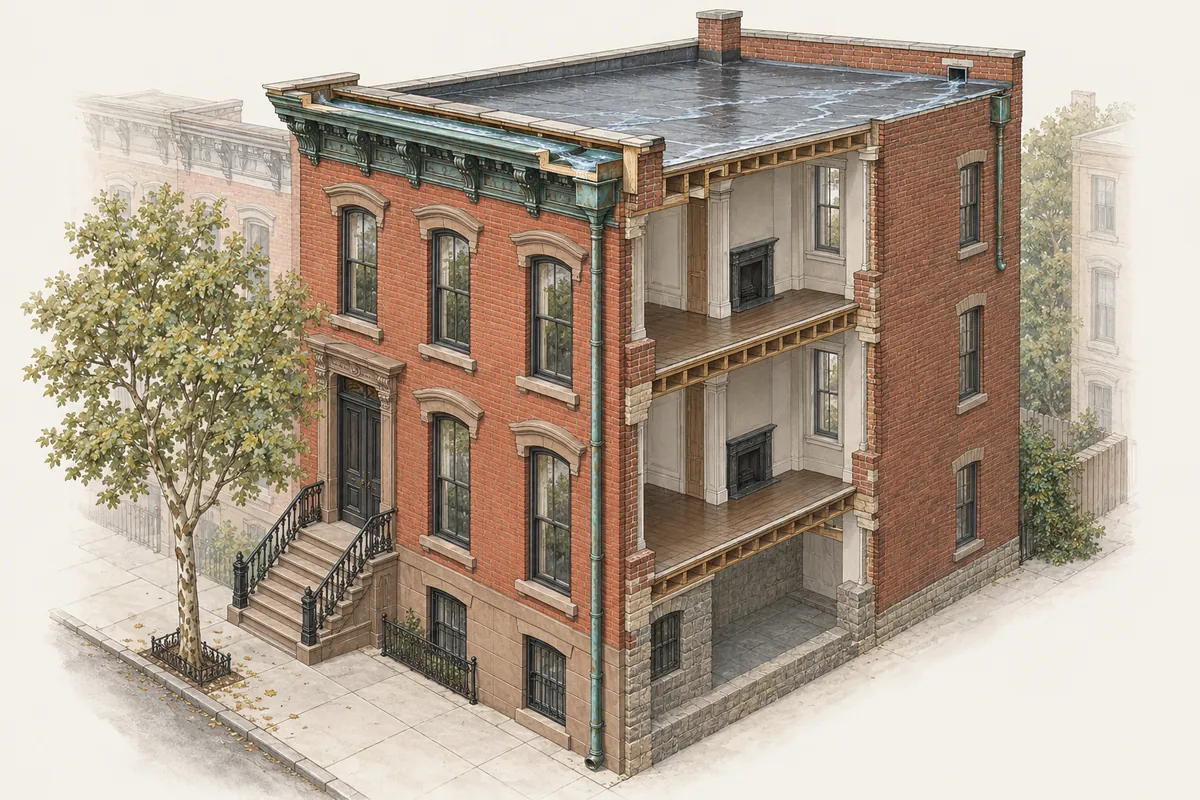
Each part has its own page: the gutter inside the cornice on box and built-in gutters, matching original metal on copper and half-round, and the conductor head, leader and rear scupper on leaders, downspouts and scuppers.
Historic district questions
Does relining a box gutter change anything HPC staff look at?
Usually not from the street, since the new lining sits inside the cornice. What staff tend to care about is whether the cornice itself, its trim or the outlet and leader change. Even so, the work needs approval before it starts, so the reline should still go through staff first.
Can aluminum replace copper on a historic front?
It depends on the house and the block. Swapping a visible copper leader or half-round gutter for aluminum changes the appearance, which is the kind of change review exists for. On rear walls not visible from the street, there is often more flexibility. Staff can say which applies.
Who files for approval, the owner or the contractor?
Either can prepare the application, but the property owner is responsible for having approval before work begins. Many owners have the contractor assemble the scope and photos, then submit with the owner's signature.