
What it is
A gutter built into the cornice
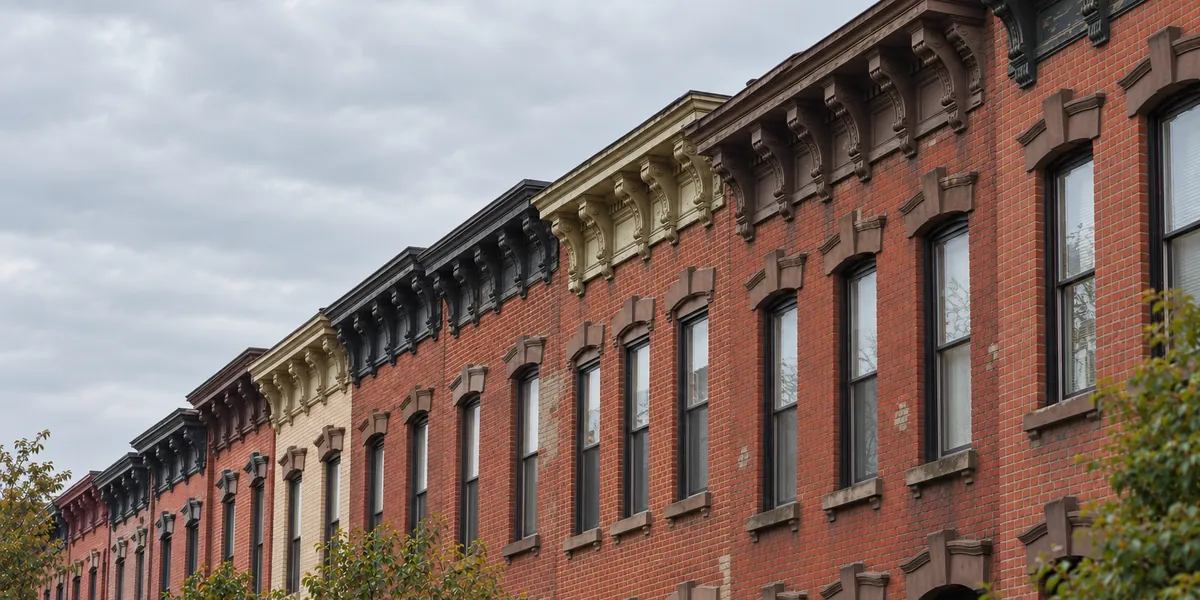
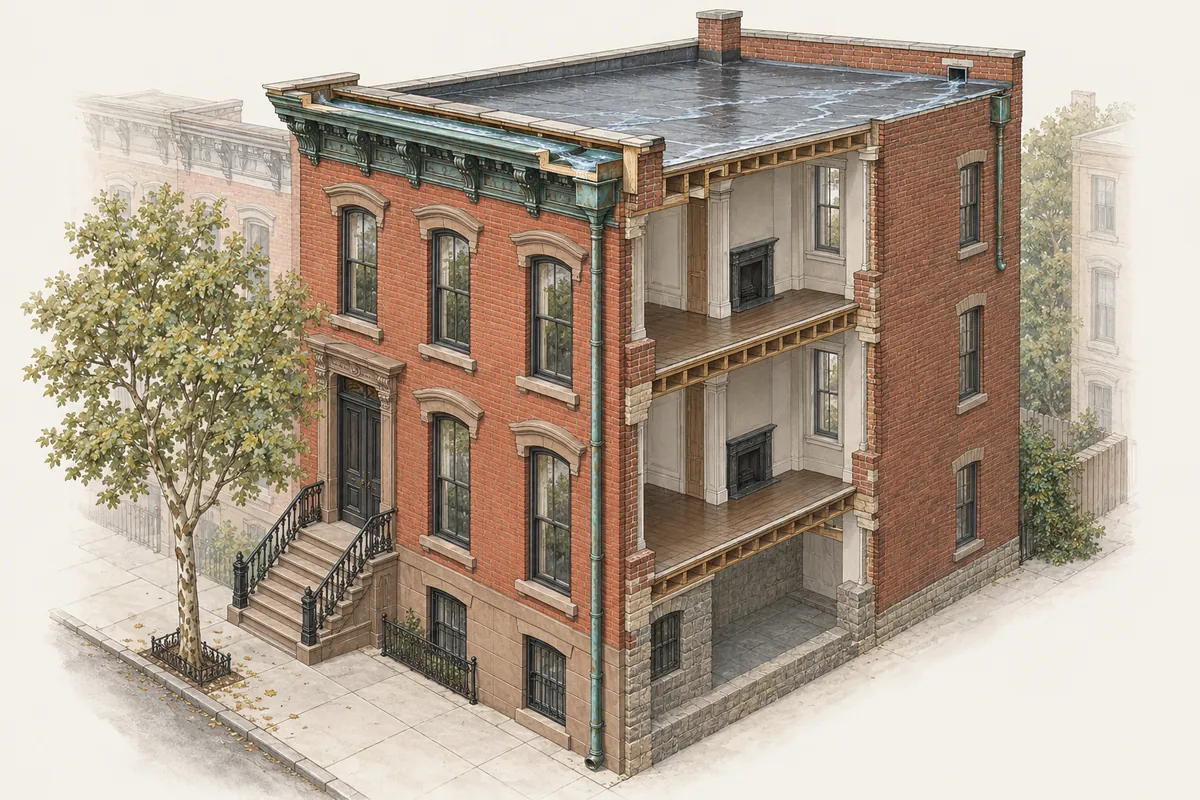
A box gutter, also called a built-in gutter, is a lined trough set into the top of a building's cornice. From the sidewalk it is invisible: the bracketed wood cornice reads as trim, and the only clue is the leader running down from one end. Rainwater runs along the trough, drops through an outlet into a conductor head, and goes down the leader.
The design is common on the brick Italianate rowhouses that line Jersey City's downtown blocks. The National Register nomination for Harsimus Cove describes rows of three-story brick houses over raised basements, with brownstone lintels, high stoops and bracketed wood cornices, built mostly between 1850 and 1887. Many of those cornices carry the gutter inside them, and on some blocks a single cornice runs across several houses.
Builders of the period favored the design because it kept the facade clean and let the cornice carry the water without a visible gutter line. The tradeoff is maintenance: the trough sits right above the front wall, so a leak goes straight into the structure instead of spilling harmlessly off the edge. Up the hill in the Heights and Greenville, where most houses are frame two- and three-families, hanging K-style gutters are more common, and those are covered on the gutter replacement page.
How they fail
The lining goes first, the wood follows
The trough itself is wood. What keeps it dry is the lining, originally metal (often tin-plated steel or copper) and on many houses today a later membrane or coating. Linings fail in predictable places:
- Seams and corners, where sheets join and movement concentrates.
- The outlet, where the trough drains into the conductor head. Leaves and seed balls from street trees pile up here first.
- Low spots, where the trough has settled and water stands instead of draining.
- Old patches, where tar or caulk has dried, cracked and pulled away.
Once water gets behind the lining, it soaks the cornice framing. The signs show up below the gutter rather than in it:
- Peeling paint or soft wood on the cornice soffit and brackets
- Dark streaks or white mineral stains on the brick below the cornice
- A stain on the top-floor ceiling along the front wall
- Water dripping from the cornice face during rain instead of from the leader
- Plants or moss growing out of the cornice line
Request a free estimate
Prefer to talk? Call (201) 293-3992, Mon–Fri 7AM–9PM.
Request received.
A local specialist will reach out shortly. Urgent? Call (201) 293-3992.
The options
Patch, reline, replace or convert
Every box gutter job comes down to four choices. Which one fits depends on the condition of the wood, how much of the lining has failed, and whether the house is in a historic district.
| Fix | When it fits | Typical cost (national) |
|---|---|---|
| Patch | One or two leaking seams on a lining that is otherwise sound | $20–$50 per linear foot for box gutter repair |
| Reline with membrane | Lining is failing along much of the run, but the wood trough is solid | $900–$1,900 for an EPDM or epoxy reline |
| Reline with metal | Matching original materials matters, or the owner wants the longest-lasting lining | Can exceed $8,000 for full metal relining |
| Replace the trough | The wood trough has rotted and has to be rebuilt | $40–$180 per linear foot |
| Convert to hanging gutters | The cornice is beyond saving, or the owner wants a simpler system to maintain | $1,500–$5,000 or more |
Cost ranges are national figures from Modernize's box gutter guide. No Jersey City or New York contractor publishes box-gutter prices, so local quotes can land outside these ranges, especially for long shared runs or work that needs scaffolding.
The reline, replace or convert guide walks through the decision in more detail, including what each choice costs over time.
Materials
What a new lining is made of
Membrane (EPDM and similar)
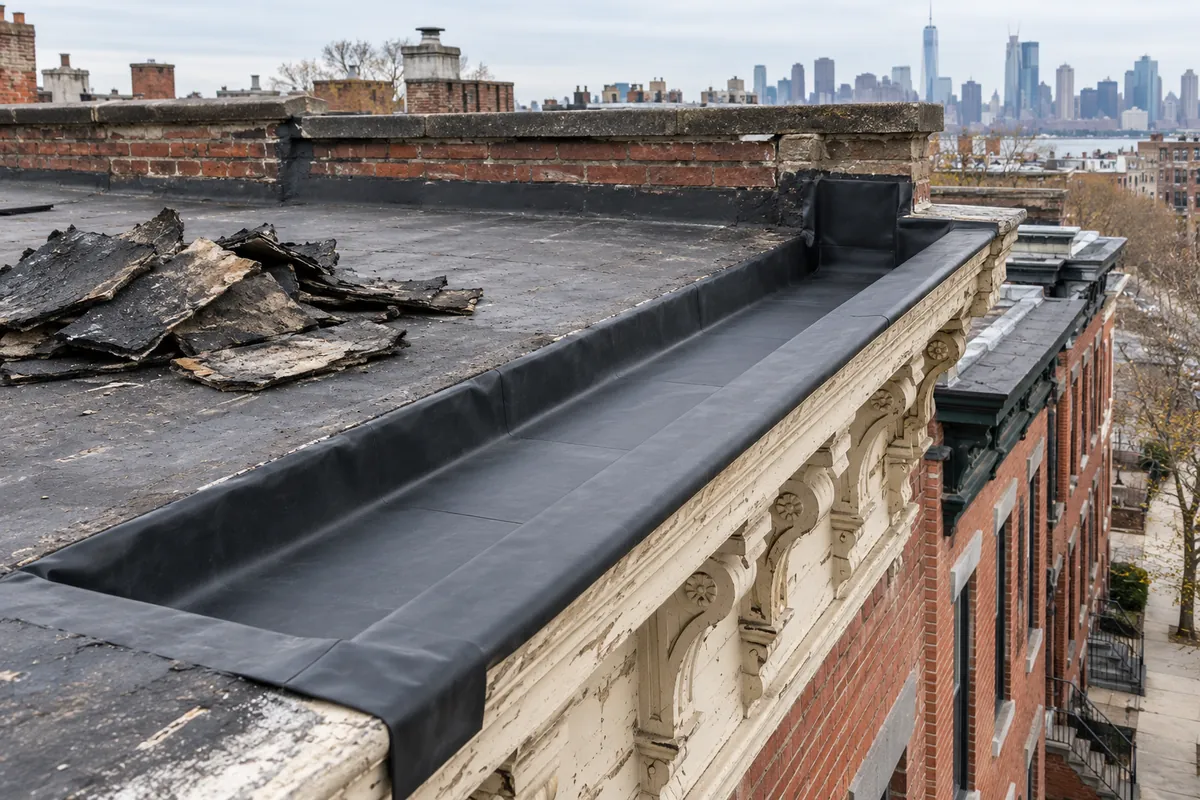
A rubber membrane is laid into the trough and turned up under the roof edge and over the front lip. It is the least expensive reline and the most common on rowhouses today. It depends on clean detailing at the outlet and the ends, where most membrane leaks start.
Copper
Copper is the traditional premium lining, soldered at the seams. Modernize puts its life at 75 to 100 years or more, and it is the material most likely to match original work on a historic block. It costs the most up front.
Lead-coated copper
Copper with a lead-tin coating weathers to a soft gray instead of green. It shows up on older restoration work where a gray finish matches nearby roofing or flashing. It is priced like copper and soldered the same way.
Copper and other metals should not touch each other directly. The copper and half-round page covers why.
Upkeep
Keeping a box gutter working between repairs
A hidden gutter gets less attention than a hanging one because nobody sees it fill. A few habits catch most problems before they reach the wood:
- Clear the outlet every fall, after the street trees drop. On blocks lined with London planes and sycamores, leaves, bark and seed balls collect at the outlet and back water up along the whole trough. Once in late fall is often not enough; the gutter cleaning page covers timing.
- Check the conductor head and leader, not just the trough. A blocked leader turns the box gutter into a basin, and the overflow goes into the cornice.
- Look at the cornice after a heavy storm. Fresh drips from the cornice face, or wet brick below it, mean water is getting past the lining.
- Avoid surface patches as a long-term fix. Roofing cement over a cracked seam can stop a leak for a season, but it traps water against the old metal and makes a proper reline harder later.
- Keep photos. Pictures of the trough from the roof, taken each year, make it easier to compare estimates and to show historic-district staff what exists today.
Guards are sometimes added to box gutters to keep debris out. Whether they work depends on the cornice detail and the roof edge; the gutter guards page explains when they fit and when they don't.
Historic districts
When the city reviews the work first
Jersey City has five local historic districts: Hamilton Park, Harsimus Cove, Paulus Hook, Van Vorst Park and West Bergen–East Lincoln Park. Exterior work there needs a Certificate of No Effect or a Certificate of Appropriateness before it starts, even when no construction permit is required (City of Jersey City, Historic Preservation). Repairs and like-for-like maintenance are typically handled at staff level.
Relining usually leaves the cornice looking the same from the street. Converting to hanging gutters changes the cornice line, so it gets closer review. Homeowners should confirm with Historic Preservation Commission staff before work begins. The historic districts page has a checklist of what to bring.
Getting an estimate
What a good box gutter estimate covers
Box gutter quotes vary more than ordinary gutter quotes because so much depends on what is under the lining. A useful estimate spells out:
- The length of the run, and whether it continues across neighboring houses
- The condition of the wood trough and cornice, with photos from the roof
- Which fix is proposed (patch, reline, replace or convert) and why
- The lining material and how the outlet and ends will be detailed
- The conductor head and leader: reused, repaired or replaced
- Access: ladder, roof hatch or scaffolding
- Any historic-district approval and who handles it
- For jobs of $500 or more, a written contract as New Jersey requires
For per-foot prices on the rest of the system, see what gutters cost in Jersey City. Leaders, conductor heads and rear scuppers are covered on the leaders, downspouts and scuppers page.
Box gutter questions
Is a Yankee gutter the same as a box gutter?
Not quite. A box gutter is a trough built into the cornice or eave, so from the street it reads as part of the trim. A Yankee gutter is formed on the roof itself: a wood strip or dam set a short way up the slope from the edge, with metal lining the channel behind it. Both are hidden gutters, both depend on their lining, and both are repaired with similar methods. Downtown Jersey City rowhouses mostly have the cornice type.
Can a box gutter be converted without changing how the cornice looks from the street?
Partly. Conversion closes off the old trough and hangs a new gutter at the edge, which adds a visible gutter line and usually a new outlet. On a block where every house shares one cornice line, that change is noticeable, which is why conversion in a historic district is normally reviewed before work starts. Relining keeps the street view the same.
Why does a ceiling stain show up near the front wall?
A box gutter sits directly over the front wall and the top-floor ceiling. When the liner cracks, water runs into the cornice framing and then into the wall cavity, so the first sign inside is often a stain along the front-wall ceiling or around the top of a front window, sometimes well away from the actual crack.
How long does a membrane reline take?
On a single rowhouse front, a membrane reline is usually a short job measured in days rather than weeks, assuming the wood underneath is sound. Rot repairs, a long shared run across several houses, or historic-district review add time. Any estimate should state the expected schedule in writing.