
The local words
Leaders, conductor heads and scuppers
In northern New Jersey and New York, a downspout is usually called a leader. On rowhouses, the parts below the gutter often include:
| Part | What it is | Where it's found |
|---|---|---|
| Leader | The pipe that carries water from the gutter down the wall | Every house; often copper on historic fronts |
| Conductor head | An open box at the top of the leader that collects water from a gutter outlet or scupper | Rowhouse fronts and rear walls |
| Scupper | An opening through a parapet wall that drains a flat roof | The rear parapet of many flat-roof rowhouses |
| Elbows and offsets | Bends that carry the leader around cornices and moldings | Anywhere the wall isn't flat |
This page is part of a short guide to how water leaves a Hudson County rowhouse. The cornice end of the system is on the box gutter page; the rules for historic blocks are on the historic districts page.
Front walls
Leaders on brick
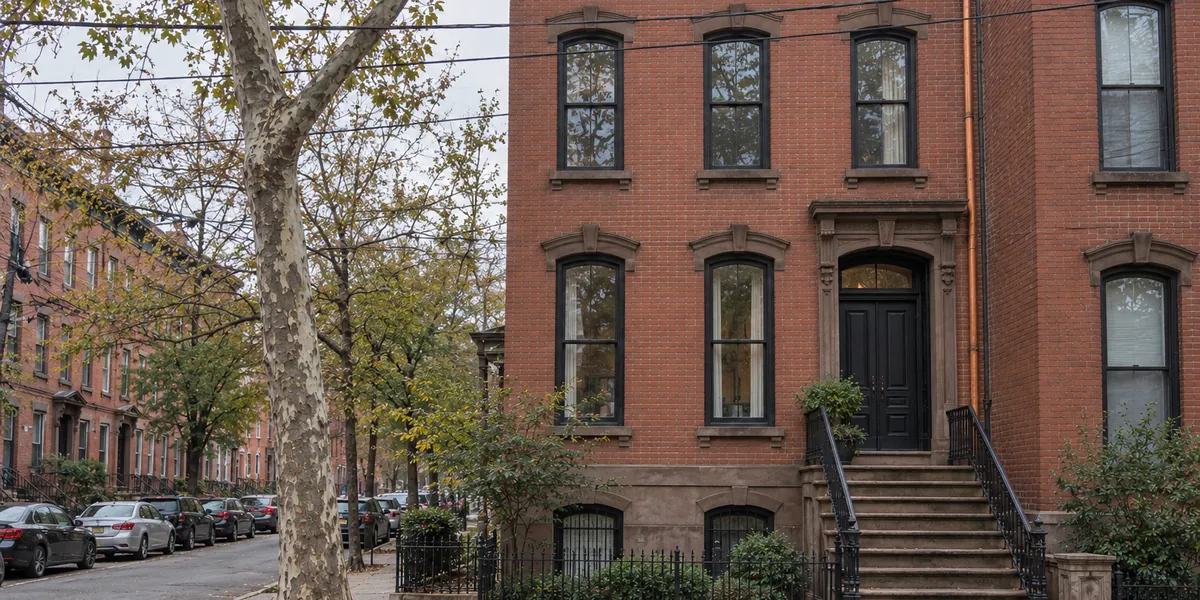
On a brick front, leaders are held by straps fastened into the wall. Fastening into the mortar joints rather than the face of the brick is generally easier to patch later, and on historic houses it avoids damaging original brick. Copper leaders are common on historic blocks, where they're matched to neighbors; aluminum is common elsewhere. Leaders that have pulled away from the wall, or that are crushed at the bottom, send water against the brick and the foundation.
Request a free estimate
Prefer to talk? Call (201) 293-3992, Mon–Fri 7AM–9PM.
Request received.
A local specialist will reach out shortly. Urgent? Call (201) 293-3992.
Warning signs
How to tell a leader is failing
- Water pouring from a joint or elbow instead of the bottom outlet
- A leader that has pulled away from the wall, or straps hanging loose
- Dark streaks, moss or white mineral stains on the brick beside it
- A crushed or dented section at sidewalk level
- Gurgling or overflow at the gutter during rain, a sign of a clog below
- Water pooling against the foundation or the base of the stoop
Most residential leaders are 2-by-3 or 3-by-4 inch rectangular pipe, or 3- or 4-inch round on half-round systems. A larger leader on a long gutter run moves water faster and clogs less often.
Flat roofs
Scuppers through the rear parapet
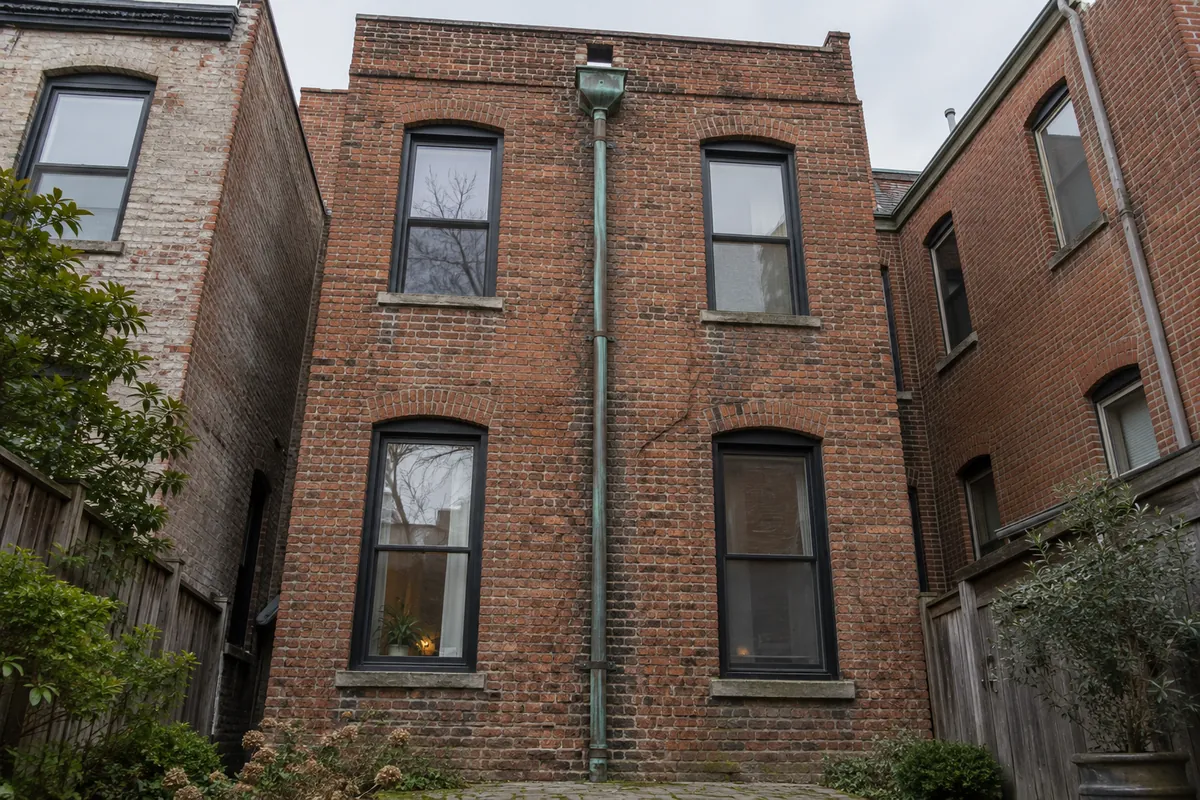
Many rowhouses have a flat roof that drains toward the back, where water leaves through a scupper in the parapet wall and drops into a conductor head and leader. Scuppers clog with the same leaves as gutters, and when they do, water ponds on the roof. Common repairs are relining the scupper opening, replacing a rusted conductor head, or enlarging an undersized scupper.
A combined-sewer city
Where the leader ends
Jersey City's sewers carry rain and wastewater in the same pipes; the JCMUA sewer rules describe mains that convey "both sanitary and storm flow." The same rules define a rain barrel as one "placed under a gutter's downspout." In 2014 the city and the JCMUA began offering $25 rain barrels that hook up to downspouts, so that captured water no longer flows "directly into the sewers" (CBS New York, July 2014).
On narrow lots, the bottom of the leader matters too. A leader that ends at a splash block next to a stoop or across a sidewalk sends water where people walk. Extensions, rerouting along the wall, or a connection to an existing drain are the usual fixes.
Below grade
Leaders that disappear into the ground
On some older houses, the leader runs into a pipe below the sidewalk or yard. When that buried section clogs or breaks, water backs up the leader and spills at the first joint, which can look like a gutter problem. Disconnecting the leader at ground level during rain shows whether the gutter or the underground line is at fault. Repairs below grade are a separate job from gutter work, and in a combined-sewer city, any change to a connection is worth checking with the JCMUA first.
Cost
What leaders cost
Installed leaders run $7.52 to $31.79 per linear foot in aluminum and $20.56 to $62.63 per linear foot in copper (Fixr, Jan 2025, national). A three-story rowhouse front needs a long leader, so material choice moves the total more than on a one-story house. See the cost guide for gutters and guards.
Leader and scupper questions
Can a leader be moved away from the front steps?
Usually. A leader can be rerouted along the wall with offsets to a different outlet, or the gutter can get a new outlet at the other end. On a historic front, a visible change like that may need review first.
What's the difference between a scupper and a roof drain?
A scupper is an opening through the side of a parapet wall, draining water off the roof edge into a leader. A roof drain sits in the roof surface and connects to a pipe inside the building. Rowhouses more often have scuppers.
Can a rain barrel go on a front leader?
It can, using a diverter that sends some water to the barrel and the rest down the leader. On a narrow front, space and appearance usually push barrels to the back of the house.