
On historic blocks
Why copper keeps showing up downtown
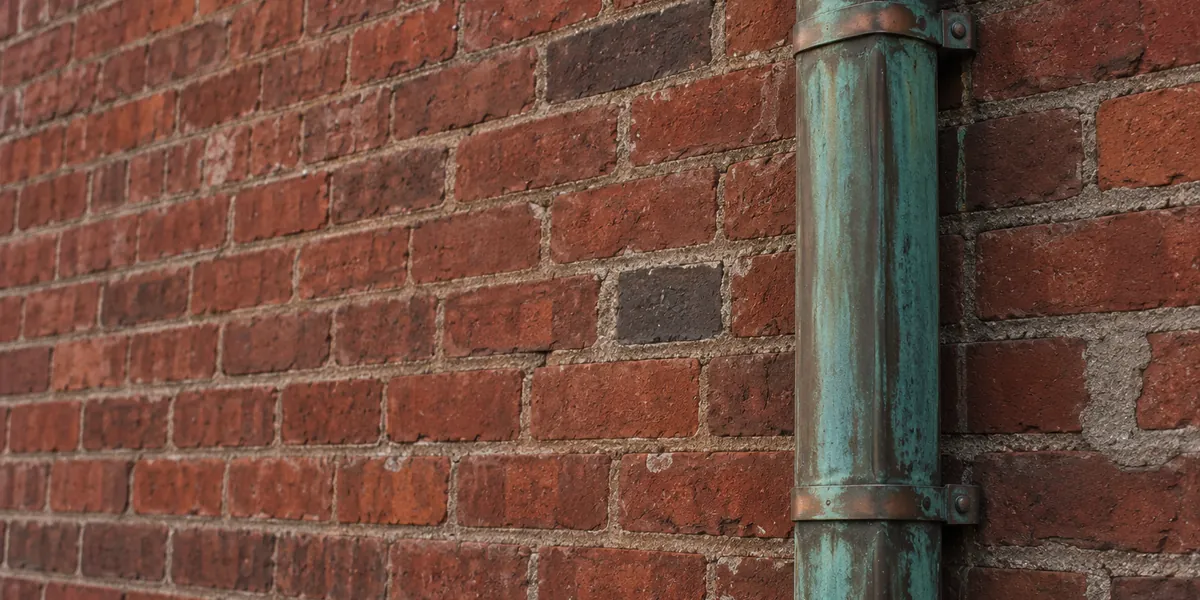
On the older streets of Paulus Hook, Van Vorst Park and Hamilton Park, copper leaders running down brick fronts are part of the look of the block. Many rowhouses were built in continuous rows, and the National Register nomination for Harsimus Cove describes houses sharing the same three-story height, brownstone trim and bracketed cornices. When one house in that kind of row replaces a leader or a hanging gutter, matching the neighbors usually means copper, and often a half-round profile.
Copper also turns up on newer work where the owner wants a gutter that lasts. The Copper Development Association notes that copper roofs can last more than 100 years, and gutters and downspouts are among its common architectural uses.
How it ages
From bright metal to green
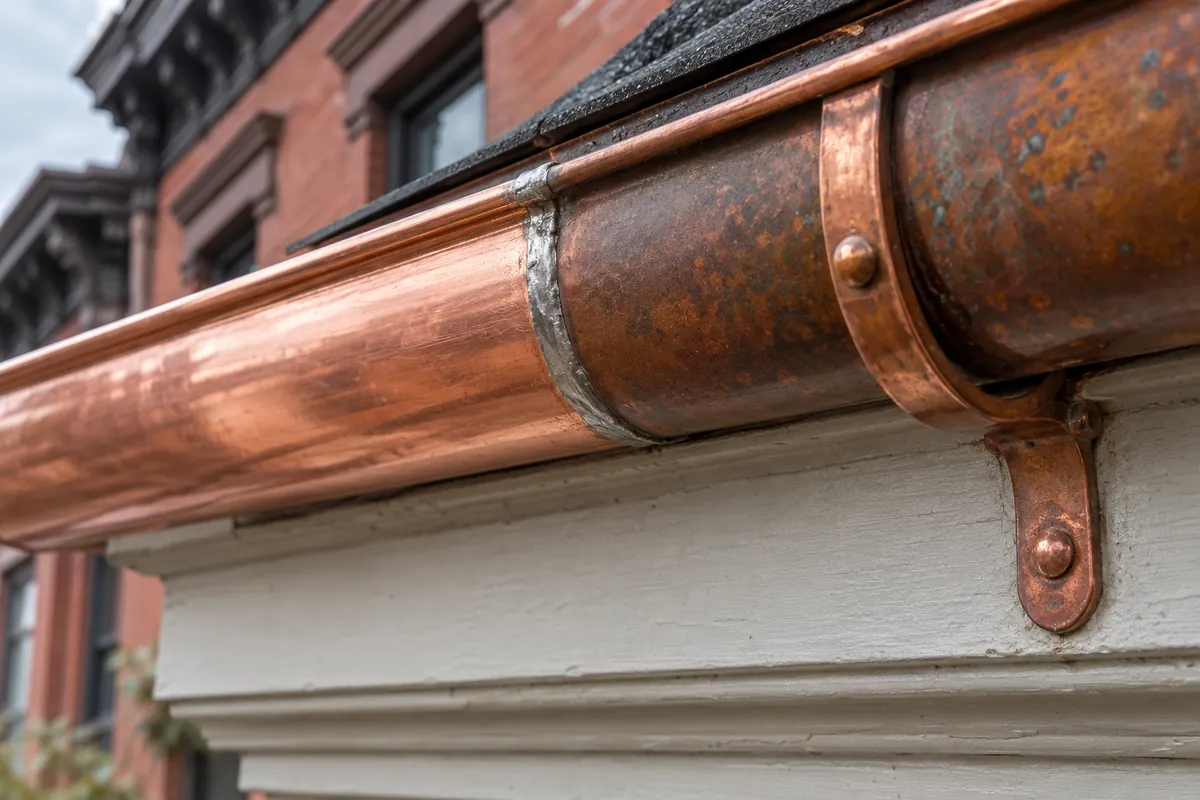
New copper is bright and pinkish. Moisture and the atmosphere oxidize the surface, and the metal moves through brown and dark brown before, in most of the country, it settles into a blue-green patina. That patina is a protective layer that slows further corrosion (Copper Development Association). How long each stage takes depends on exposure, so a leader on a sheltered rear wall and one on a sunny street front can look different for years.
Stages shown in order only. Timing varies with exposure and is not shown to scale.
Request a free estimate
Prefer to talk? Call (201) 293-3992, Mon–Fri 7AM–9PM.
Request received.
A local specialist will reach out shortly. Urgent? Call (201) 293-3992.
Profiles
Half-round or K-style
| Profile | Looks like | Where it fits |
|---|---|---|
| Half-round | A simple open half-circle, usually hung on round brackets | Older and historic houses, and anywhere matching a traditional look matters |
| K-style | A flat back with a decorative front that resembles crown molding | Most frame two- and three-families and newer houses; carries more water for its width |
Both profiles come in copper and in aluminum. Half-round adds about $1 to $2 per linear foot over standard K-style (HomeGuide, Oct 2025).
Details that matter
Seams, hangers and mixed metals
Copper gutters are joined with soldered seams rather than sealant, which is a large part of why they last. Hangers and fasteners should be copper too.
Copper should not be paired directly with aluminum. When two different metals touch with water present, the more reactive one corrodes, and an industry article in the Journal of Light Construction notes that copper "may cause damage to the more-reactive aluminum." A copper leader fitted to an aluminum gutter, or copper hangers on an aluminum run, needs a proper separation or a different design.
Old copper
Repairing copper instead of replacing it
Because copper lasts so long, much of the copper on Jersey City's older houses is worth repairing rather than replacing. Common repairs include:
- Re-soldering open seams, which is the most frequent copper repair and keeps the original metal in place.
- Replacing a damaged section, such as a crushed length of leader at sidewalk level, with new copper soldered in.
- Resetting hangers and straps, since the brackets often fail before the gutter does.
- Rebuilding a conductor head where the solder joints or the bottom have worn through.
Patching copper with roofing cement or tape is a short-term fix that is hard to undo. Soldered repairs match the way the system was built.
Living with copper
Stains, paint and the stone below
Water that runs off copper can leave green streaks on light-colored stone, concrete and painted trim beneath it. On a brownstone stoop or a limestone sill, that staining is hard to remove, so leader outlets and splash blocks are best placed where runoff misses the stone.
Copper should not be painted to slow the patina. Paint peels unevenly, and the natural patina is what protects the metal. Owners who want copper to stay bright can have it cleaned and coated, but the coating has to be renewed, and most historic blocks favor the weathered look anyway.
For houses where copper is not required, aluminum half-round and copper-colored aluminum give a similar shape for far less. Lead-coated copper, which weathers to gray instead of green, shows up on some restoration work and is covered on the box gutter page.
Cost
What copper costs
Installed copper gutters typically run $25 to $40 or more per linear foot (HomeGuide, Oct 2025, national), several times the price of aluminum. Copper leaders run $20.56 to $62.63 per linear foot installed (Fixr, Jan 2025, national). On a rowhouse, the run is short, so the total is often less than the per-foot price suggests. The cost guide compares copper with every other option.
Copper gutter questions
Can new copper be made to look old right away?
Yes. Pre-patinated copper, or a chemical patina applied after install, can make new work match weathered neighbors from the start. It costs more than plain copper, and the applied finish can weather unevenly, so it is worth asking to see a sample that has been outdoors.
Can a copper leader connect to an existing aluminum gutter?
Not directly. Copper touching aluminum in the presence of water causes the aluminum to corrode. The usual answers are an isolating connector, replacing the short run that connects them, or keeping the whole system one metal.
Do half-round gutters come in aluminum?
Yes. Aluminum half-round is common and costs far less than copper. It gives the traditional shape on a house where copper isn't required to match neighbors.