
By symptom
What it's doing, and what usually fixes it
| Symptom | Likely cause | Usual fix |
|---|---|---|
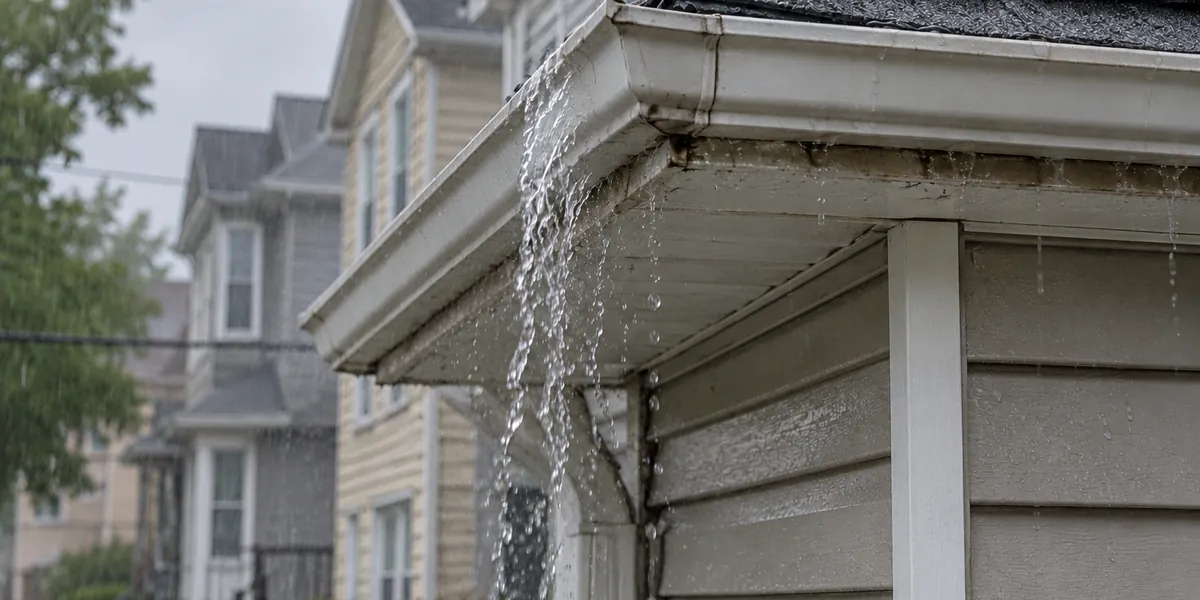
| Drip at a joint | Failed sealant at a seam or end cap on a sectional gutter | Clean and reseal the joint, or replace the connector |
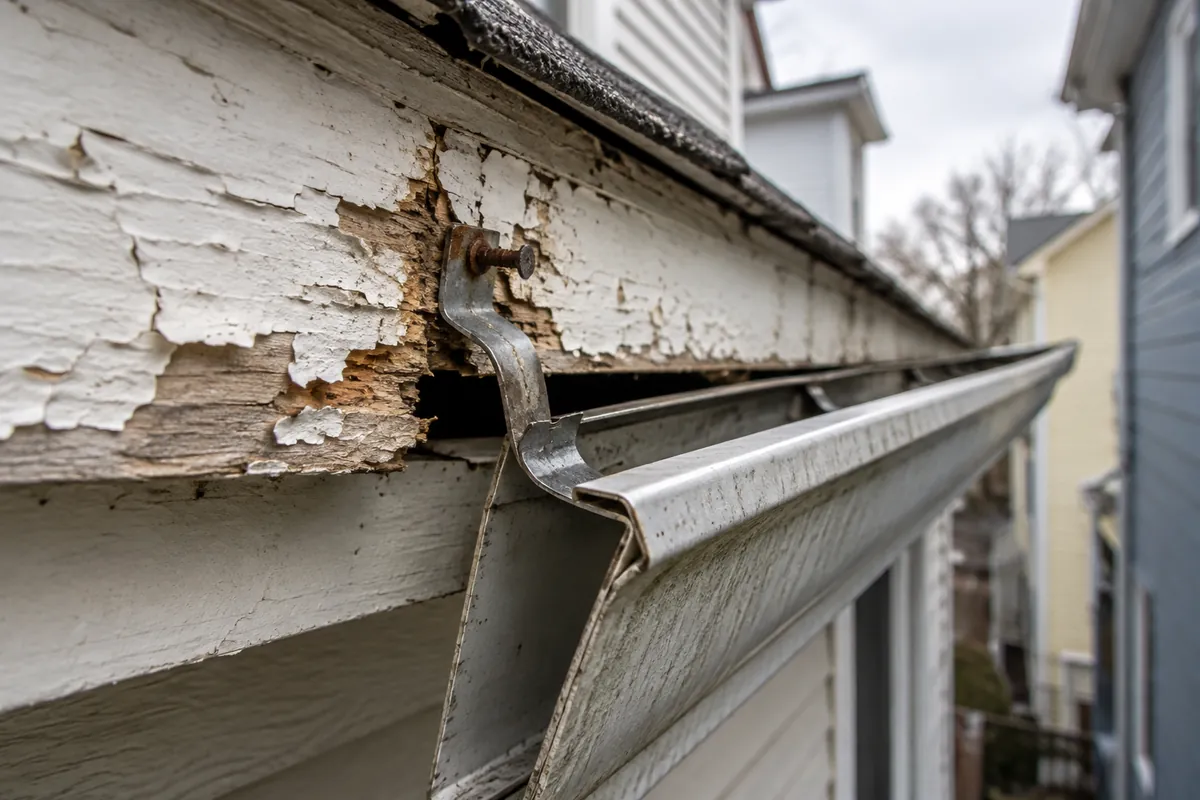
| Sagging section | Hangers pulled loose, or too far apart; rotted fascia behind them | Reset or add hangers; replace soft fascia first |
| Spikes backing out | Old spike-and-ferrule hangers loosening as the wood dries and swells | Swap spikes for screw-in hidden hangers |
| Overflow at a corner | Clogged outlet, or too much roof draining to one spot | Clear the outlet; add a leader or a corner diverter |
| Water behind the gutter | Gutter set too low, or missing drip edge | Rehang higher, or add flashing behind the gutter |
| Leader pulled off the wall | Broken straps or a crushed elbow | New straps and elbows; reconnect at the outlet |
By material
Repairs differ by metal
- Aluminum: joints are resealed, dents can be straightened or a section replaced, and seamless runs can be patched at a leak with a matching piece.
- Galvanized steel: small rust spots can be cleaned and sealed, but rust through the bottom usually means replacing the run.
- Copper: open seams are re-soldered rather than caulked; see copper and half-round.
- Vinyl: cracked sections are replaced, since patches rarely hold through a winter.
Rowhouses vs. frame houses
Two different repair jobs
On a frame house, most repairs happen at the roof edge, from a ladder, on hanging gutters. On a brick rowhouse with a cornice gutter, the same symptom, water where it shouldn't be, usually means the hidden lining has failed, and the fix is a patch or reline inside the cornice. Those repairs are covered on the box gutter page. Leaders and rear scuppers have their own page: leaders, downspouts and scuppers.
Request a free estimate
Prefer to talk? Call (201) 293-3992, Mon–Fri 7AM–9PM.
Request received.
A local specialist will reach out shortly. Urgent? Call (201) 293-3992.
On city houses
Repairs that come up often on tight lots
Narrow lots and busy sidewalks create their own wear patterns:
- Leaders crushed at street level, where they share space with trash bins, bicycles and stoop railings. The bottom few feet take the damage, and a crushed elbow backs water up the whole leader.
- Gutters bent by street-tree limbs, after storms or heavy wet snow, especially on the street side of frame houses.
- Rear gutters on back extensions, which are low, easy to forget, and often the first to overflow onto a yard or a neighbor's fence.
- Ends at shared walls, where one house's gutter stops against the next house and water finds its way into the gap between them.
Most of these are short repairs when caught early. Left alone, they push water into walls, foundations and the neighbors' property.
A good repair visit
What should be checked while the ladder is up
A repair call is a chance to look at the whole system, not just the leak that prompted it. A thorough visit covers:
- Every outlet, to make sure water actually leaves the gutter
- The leaders, flushed from the top to find clogs and crushed elbows
- Hangers along the full run, not just near the problem
- The fascia behind the gutter, for soft spots
- End caps and corners, where sealant fails first
- Where each leader ends, and whether water is getting back against the house
When to stop repairing
When a repair is really a replacement
A repair makes sense when the problem is in one place. When the same gutter has leaks at several seams, keeps sagging after hangers are reset, or has rusted through, each repair buys less time than the last. At that point, the replacement page is the better place to start.
One cost detail: in New Jersey, gutter repairs are taxable, while new gutters installed as a capital improvement are exempt with Form ST-8 (NJ Division of Taxation, S&U-2). On a borderline job, that difference is worth asking about.
Repair questions
Can a sagging gutter be re-pitched instead of replaced?
Often, yes. If the gutter itself is sound, it can be taken down, rehung on new hangers at the right slope and resealed. If the fascia behind it is soft, the board has to be replaced first, or the new hangers will pull out too.
Is a leaking corner worth fixing on an old gutter?
If the rest of the run is sound, yes. A resealed or replaced corner is a small job. If the corner is one of several leaks on a gutter that's already sagging or rusting, the money is usually better put toward replacement.