
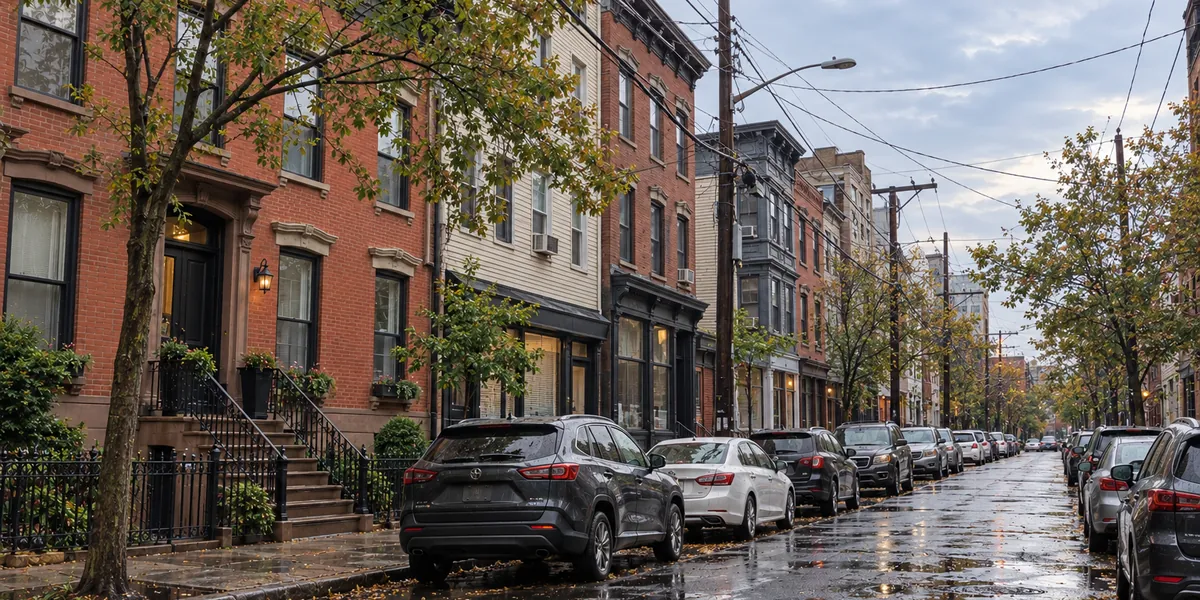
The problem
A city that floods at 0.8 inches an hour
Hoboken sits low between the Hudson and the Palisades, and much of it drains through a combined sewer system. According to the City of Hoboken, that system can be overwhelmed by "as little as 0.8 inches of rain per hour," which leads to flooding "in streets and basements." For comparison, Newark recorded 3.24 inches in a single hour during Ida in 2021 (NRCC).
The city has spent years on pumps, storage tanks and parks designed to hold water. They work most of the time. The rest of the time, every roof on the block is sending water toward the same streets at once.
By the numbers
What the pumps handle, and what they don't
Rain per hour that can overwhelm the system, leading to flooding in streets and basements.
Share of rainstorms in which the H1 and H5 flood pumps have prevented flooding since 2016.
Stormwater storage tank under ResilienCity Park in northwest Hoboken.
All three figures from the City of Hoboken and North Hudson Sewerage Authority, April 24, 2025.
Roughly one storm in eight still gets ahead of the system. Those are the storms where gutters and leaders are tested hardest: a clogged conductor head overflows against the brick, a leader that ends at the foundation puts water where the basement already has it, and a rear-yard drain that backs up has nowhere to go.
Request a free estimate
Prefer to talk? Call (201) 293-3992, Mon–Fri 7AM–9PM.
Request received.
A local specialist will reach out shortly. Urgent? Call (201) 293-3992.
On a Hoboken rowhouse
Getting ready for the eighth storm
Most Hoboken houses are attached rowhouses and multifamily buildings on narrow lots, so the choices are about where water leaves the roof and where it lands:
- Clear gutters, conductor heads and rear scuppers before the stormy months, not after
- Make sure each leader runs freely from top to bottom, with no crushed elbows at sidewalk level
- Check where every leader ends; one that drops water at the foundation wall feeds the basement
- Look at rear-yard drains, which back up first when the street system is full
- On flat roofs, confirm the scupper is not partly blocked, since ponding water finds the weakest seam
- Consider larger leaders or an added outlet on long runs that overflow in heavy bursts
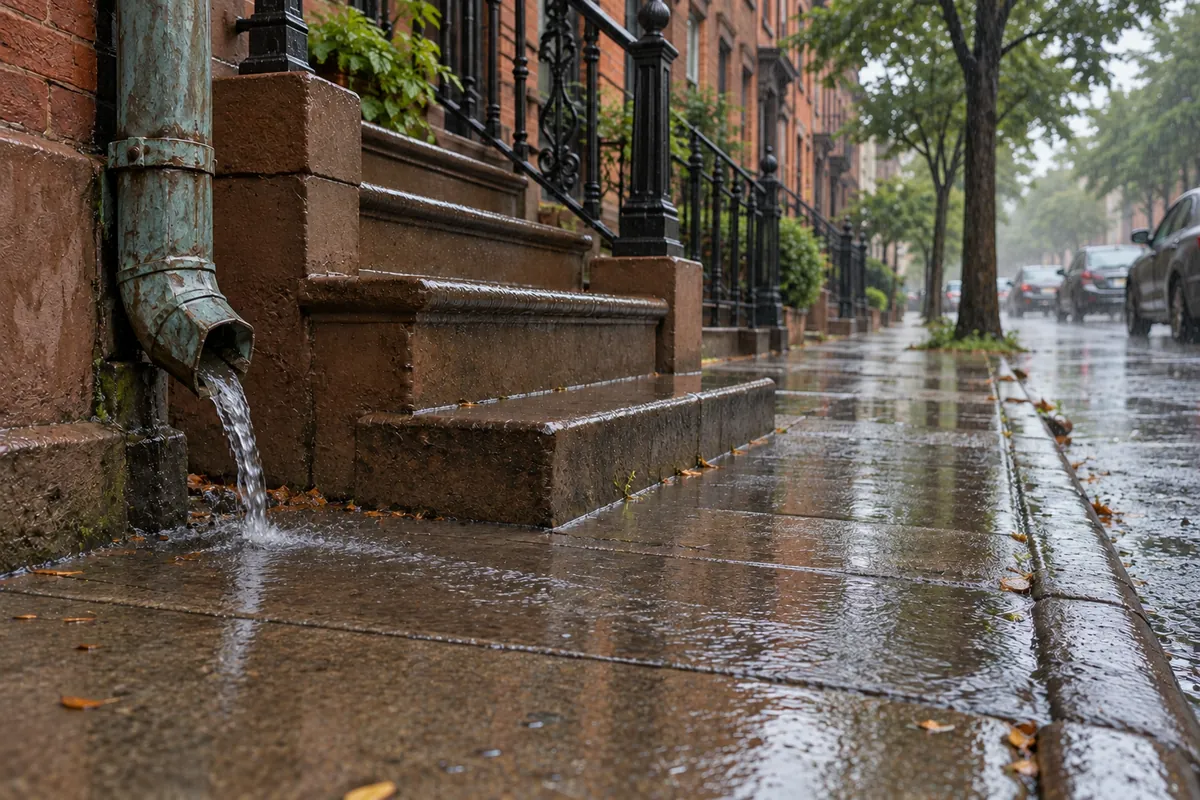
The leaders, downspouts and scuppers page covers conductor heads, scuppers and where leaders should end.
Behind the house
Rear extensions, yards and flat roofs
Many Hoboken rowhouses have a rear extension with its own low roof and a short gutter, plus a flat main roof that drains to the back through a scupper. Those rear systems are easy to forget because they can't be seen from the street, and they drain into small yards where there is little room for water to spread out. A rear yard drain, an extension that carries leader water toward it, and a scupper kept clear of leaves make the difference between a wet yard and a wet basement when the street system is already full.
Historic Hoboken
When the street view changes
Hoboken's Historic Preservation Commission reviews "any exterior addition, renovation, or alteration visible to the public" in the city's locally designated historic district. Replacing a visible leader with a different material or size, or changing a cornice gutter, can fall under that. The preservation office at City Hall can confirm what a specific job needs. For how Jersey City's process compares, see gutters in Jersey City's historic districts.