
Where it fits
Built for frame two- and three-families
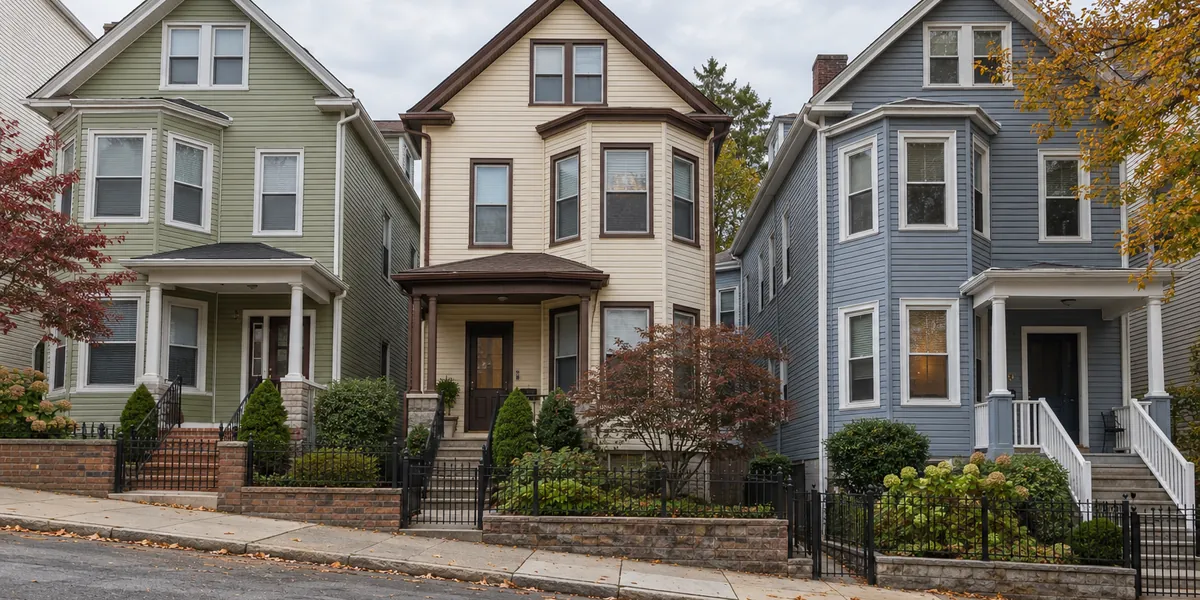
Up the hill from downtown, in the Heights, Journal Square and Greenville, much of the housing is frame two- and three-family buildings on narrow lots. Two-unit buildings alone make up about a fifth of Jersey City's housing (Census ACS 2023). These houses have open roof edges with fascia boards, which is where hanging seamless gutters belong. Newer infill houses across the city are built the same way.
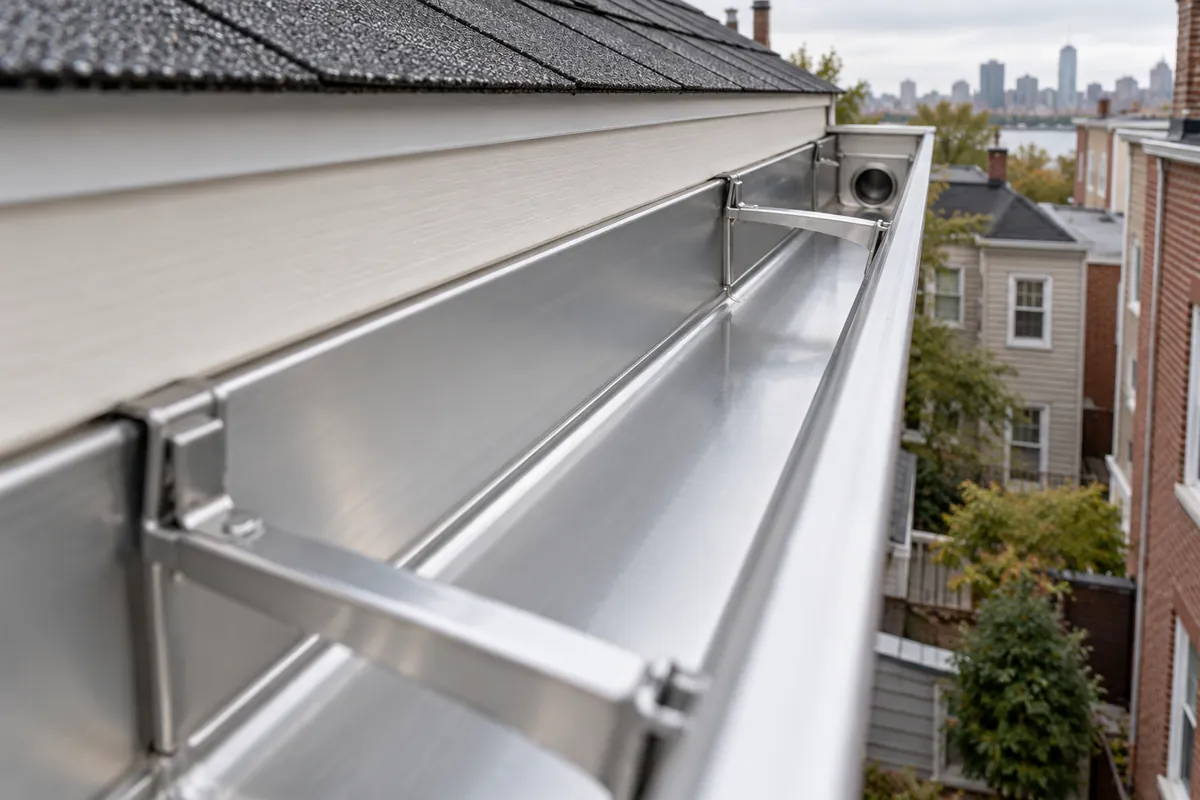
Seamless gutters are formed in one piece for each run, so the only joints are at corners and outlets. Fewer joints means fewer places to leak. Seamless gutters cost about $3 to $5 more per linear foot than sectional gutters (HomeGuide, Oct 2025, national); locally, seamless aluminum is listed at $8 to $15 per linear foot installed (Everlast Gutters' Jersey City price page, 2026).
Seamless or sectional
The difference, side by side
| Seamless | Sectional | |
|---|---|---|
| How it's made | Rolled on site from a coil, one piece per run | Pre-cut lengths joined with connectors |
| Joints | Only at corners and outlets | Every 10 feet or so, plus corners and outlets |
| Where leaks start | Corners and end caps | Every connector, as the sealant ages |
| Cost | About $3–$5 more per foot | Lower up front |
| Best fit | Most houses with long straight runs | Short runs, small repairs, do-it-yourself work |
Cost difference from HomeGuide, Oct 2025, national.
Sizing
Sized for a cloudburst
On September 1, 2021, the remnants of Ida dropped 8.41 inches of rain on Newark, its wettest day on record, and 3.24 inches fell in a single hour (Northeast Regional Climate Center). No ordinary gutter is sized for an hour like that. But bursts of heavy rain are the reason many installers recommend 6-inch gutters and larger leaders on steep or large roofs in this area, and the reason the number and placement of leaders matters as much as the gutter itself.
Request a free estimate
Prefer to talk? Call (201) 293-3992, Mon–Fri 7AM–9PM.
Request received.
A local specialist will reach out shortly. Urgent? Call (201) 293-3992.
The process
How an installation goes
- Measure the roof edgesEach run is measured, along with the roof area that drains to it, the pitch, and where leaders can come down without crossing a door or stoop.
- Form the gutter on siteSeamless gutters are rolled from a coil of aluminum in a machine on a truck, cut to the exact length of each run, so there are no joints along the straight sections.
- Set the pitchThe gutter is hung with a slight slope toward each outlet. Too little and water stands; too much and it shows from the street.
- Hang it on hidden hangersHangers clip inside the gutter and fasten through the fascia into the rafter ends. Spacing depends on the gutter size and the local snow load.
- Cut outlets and attach leadersOutlets are cut where the leaders go, and leaders are strapped to the wall and run down to a drain, extension or splash block.
- Test with waterA hose run along the gutter shows any standing water, drips at the end caps, or a leader that backs up.
Narrow lots
Where the leaders can go
On a 20- or 25-foot-wide lot, there are few good places for a leader to come down. A new installation is the best chance to plan them well:
- Away from the stoop and front door, so water doesn't land where people walk or freeze on the steps.
- Along a side alley or driveway, where there is room for an extension to carry water away from the foundation.
- Not onto a neighbor's property, which matters on houses only a few feet apart.
- Into an existing drain where one is in place and working, rather than across the sidewalk.
Adding a leader at the back of the house is often easier than enlarging the gutter at the front. The leaders, downspouts and scuppers page covers what happens after the water leaves the leader.
Before the gutter goes up
The fascia and the roof edge
A new gutter is only as solid as the board it hangs on. On older frame houses, the fascia behind the old gutters has often absorbed years of overflow. Soft spots, peeling paint and gaps at the corners are signs it needs replacing first. Some installers wrap new or existing fascia in aluminum trim at the same time, which protects the wood but can hide rot if the boards were not checked first.
The roof edge matters too. A strip of drip edge flashing under the bottom row of shingles directs water into the gutter instead of behind it. Where it is missing, water can run down the fascia even with a brand-new gutter in place.
Color and finish
Matching the house
Seamless aluminum comes in a wide range of factory colors. On frame houses, gutters usually match the trim and leaders match either the trim or the siding, so they disappear against the wall. White, brown and black are the most common; darker colors show less dirt from roof runoff. On houses next to brick rowhouses, a copper-colored or dark bronze finish can sit more quietly on the block.
Before signing
A spec sheet to ask for
Questions that pin down a quote
- Gutter size
- 5-inch or 6-inch, and why for this roof.
- Metal thickness
- The gauge of the aluminum. Heavier stock dents and sags less.
- Hangers
- Type and spacing, and whether they fasten into rafter ends or just the fascia board.
- Leaders
- How many, what size, and where each one ends.
- Fascia
- Whether rotted fascia boards get replaced first, and at what price.
- Color
- Gutter and leader colors, and whether they match the trim.
- Contract
- For jobs of $500 or more, New Jersey requires a written contract.
For full price ranges, including 6-inch and copper, see the cost guide. Owners weighing new gutters against fixing the old ones can start with the replacement page.