

The debris
What street trees put in a gutter
Jersey City's tree canopy is modest, about 17 percent, but on many blocks it is dominated by one kind of tree. The city's tree canopy report notes "a preponderance of sycamores," with streets like JFK Boulevard lined with them (Green Infrastructure Center). The London plane, the most common sycamore relative on city streets, sends three kinds of debris onto roofs:
- Leaves that are large, thick and maple-like, which mat together when wet.
- Bark that peels off in curls and large flakes.
- Seed balls, which turn brown in fall and stay on the tree into winter (Oregon Department of Forestry), then break apart into fluff and seeds.
That last point is why one fall cleaning often falls short on these blocks: debris keeps coming after the leaves are down.
Request a free estimate
Prefer to talk? Call (201) 293-3992, Mon–Fri 7AM–9PM.
Request received.
A local specialist will reach out shortly. Urgent? Call (201) 293-3992.
Guard types
Four kinds of guards, compared
| Type | How it works | Handles well | Watch for |
|---|---|---|---|
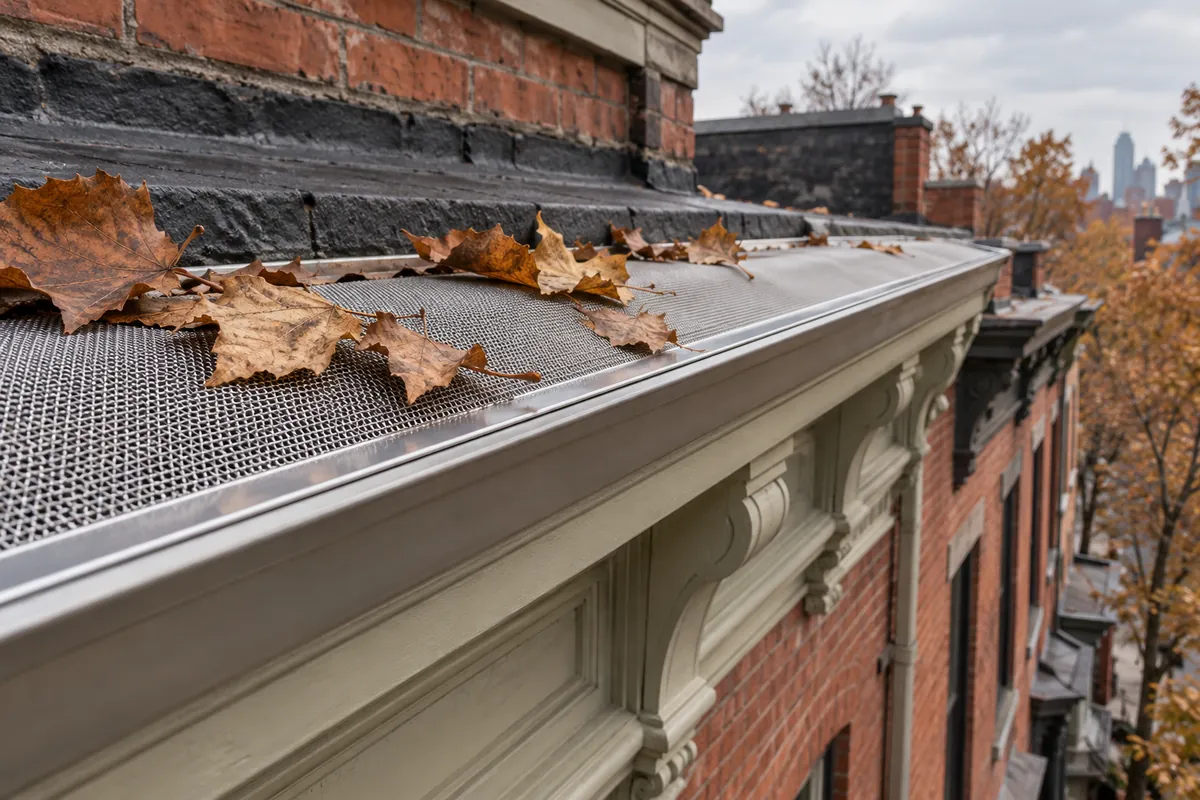
| Micro-mesh | Fine stainless or aluminum mesh over a frame, covering the gutter | Leaves, bark and most seed fluff | Fine debris can sit on top and needs brushing off now and then |
| Screens | Perforated metal or plastic panels with larger openings | Large leaves | Seed fluff and small debris pass through; plastic can warp |
| Reverse-curve covers | A solid hood; water follows the curve into a slot while debris slides off | Heavy leaf fall | Visible from the street; heavy bursts can overshoot the slot |
| Foam or brush inserts | Fill the gutter so debris stays on top | Low cost, easy to install | Hold debris and need replacing more often |
No guard makes a gutter maintenance-free. All of them still need an occasional check, especially after a heavy fall season.
Fit
How guards attach, and why it matters
Guards attach in one of three ways: slid under the first row of shingles, fastened to the front lip of the gutter, or screwed to the fascia. Each has a tradeoff. Guards under the shingles sit at the right angle but can conflict with shingle-maker rules. Guards on the gutter lip are easy to remove for checks. Fascia-mounted guards stay put in wind but are harder to take off. On a steep roof with heavy runoff, the attachment and angle decide whether water reaches the gutter or shoots past it.
Rowhouses
Guards on box gutters
Box gutters built into a cornice are wider and shaped differently from hanging gutters, and many guards are designed only for K-style profiles. Mesh panels can be cut to fit some box gutters, especially where the trough is open and level. On others, where the roof edge sits above the trough or the outlet is tucked into a corner, a guard can make cleaning harder without keeping much out. The box gutter page covers the outlet, where most trouble starts.
Limits
What guards don't fix
A guard keeps debris out. It doesn't fix a gutter that is already failing. Before guards go on, these problems should be repaired first, because a guard makes them harder to reach:
- Leaking seams and end caps
- Sagging sections or loose hangers
- A gutter pitched the wrong way, so water stands
- Undersized gutters or too few leaders
- Clogged leaders and conductor heads, which a guard on top won't clear
Flat-roof scuppers can't take a standard guard. A strainer or screen at the scupper opening does the same job; see leaders, downspouts and scuppers.
Choosing
Matching the guard to the block
The right guard depends on what lands on the roof:
- Under large plane trees or sycamores: fine micro-mesh, because seed fluff and bark flakes get through coarser screens.
- Under oaks or maples with few seeds: screens or covers handle large leaves at a lower price.
- On a house far from big trees: guards may not be worth it; one cleaning a year may be enough.
- On copper gutters: copper or stainless steel mesh only.
Cost
What guards cost
Installed guards run $15 to $45 per linear foot nationally (HomeGuide, Oct 2025). Jersey City price pages list $15 to $25 per linear foot (Everlast Gutters' Jersey City price page, 2026) and $22.50 per linear foot (CleanPro Gutter Cleaning's Jersey City page, 2026). Whether that beats repeat cleaning depends on how many cleanings a year a house needs; the guards vs. cleaning guide does the five-year math with local prices.
Gutter guard questions
Do guards keep out plane-tree seed balls?
Fine micro-mesh keeps out most of the seeds and fluff when the balls break apart. Screens with larger openings let much of it through. Whole seed balls tend to roll off covered gutters.
Do gutters with guards still need checking?
Yes. Debris can build up on top of mesh, and conductor heads and leaders can still clog. A look after the leaves are down and again in late winter catches most problems.
Can guards go on copper gutters?
Yes, but the guard and fasteners should be compatible with copper, such as copper or stainless steel mesh. Aluminum guards touching copper can corrode.
Do guards affect a roof warranty?
Some guards slide under the first row of shingles, and some shingle makers have rules about that. Owners with a roof under warranty should check the shingle maker's terms before choosing a guard that attaches under the shingles.